- Defroster-Safe Method
- Same-Day Service
- Removal + New Tint in One Visit
- 2,000+ Cars Tinted

When it’s time to take that window tinting off your vehicle, you need an experienced team who can do tint removal service quickly without damaging anything. As experienced tint professionals, we’ll get the job done right, including rear glass with defroster lines, all done in just a few hours.
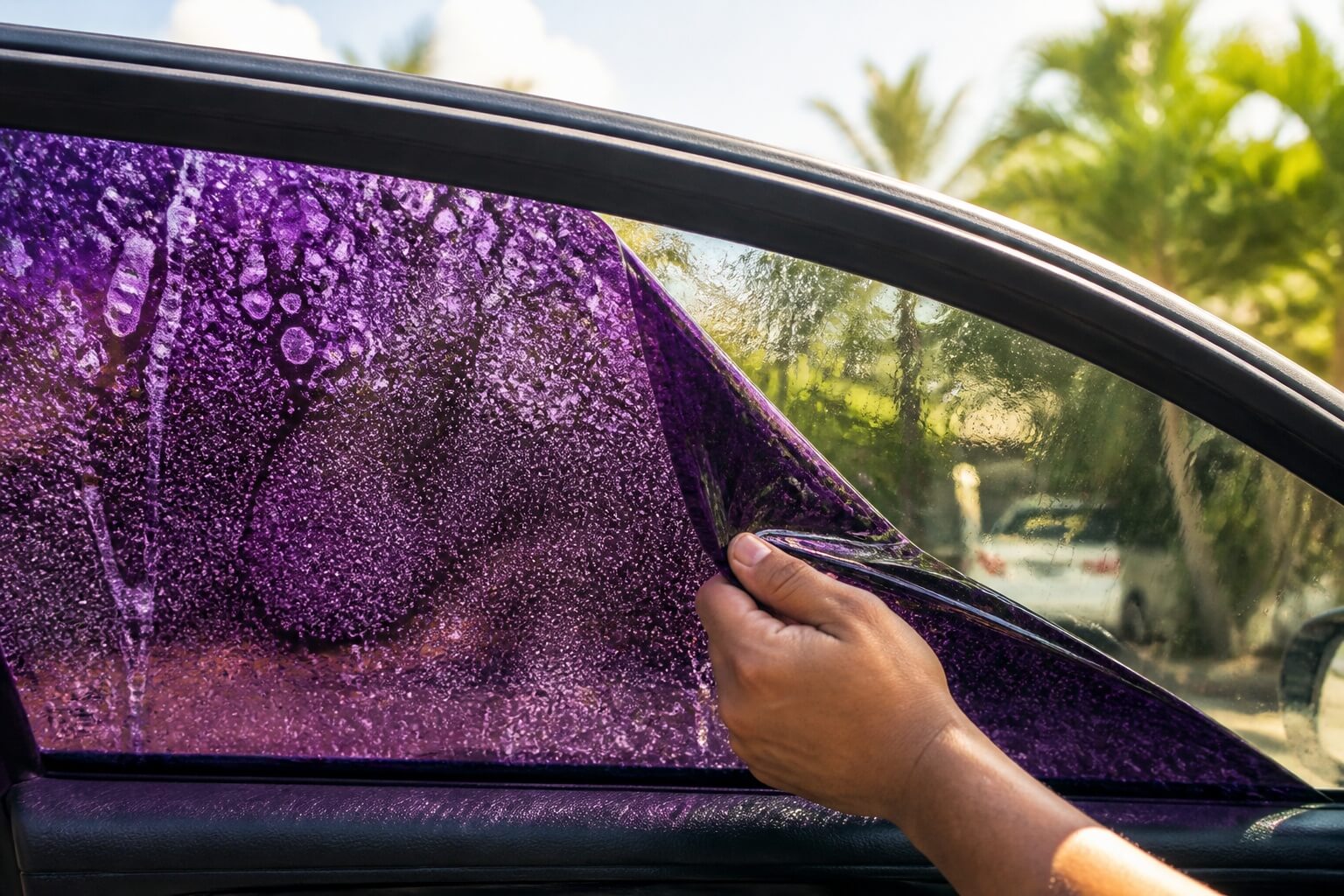
If you start to see purple bubbling, peeling, or haziness, the film is beyond repair, and it's time to get it replaced.
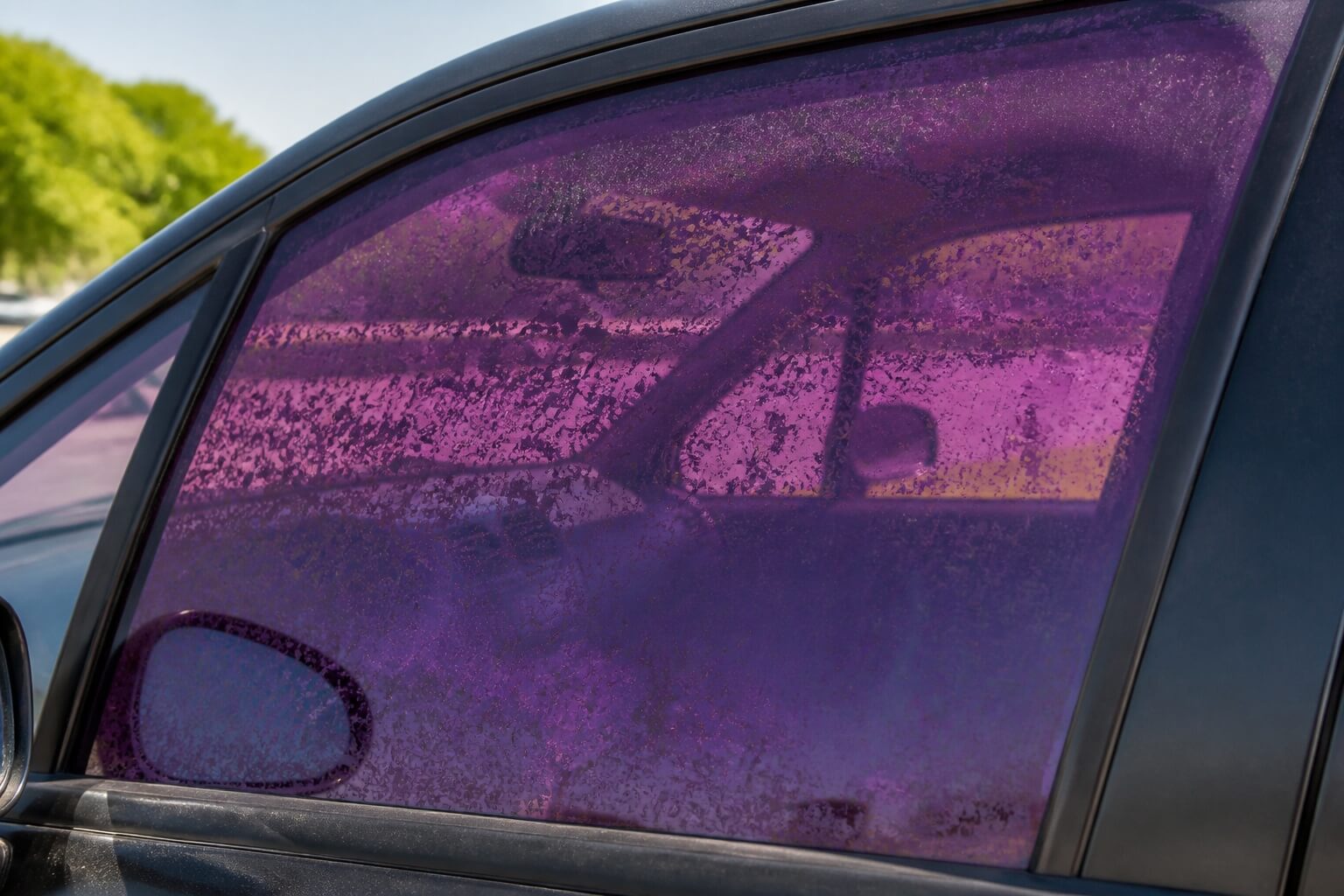
This shows that the dye has broken down, and the film needs replacing.
If you see small bubbles spreading from the edge inwards, it shows adhesive failure that cannot be fixed.
The film is lifting away, and usually begins at the top of the glass.
A sign the film is degraded and needs replacing, usually easiest to see when driving into a low sun.
Once the surface layer has been damaged, there is no fix; replacement is the only option.
Florida has strict limits for tints. If you buy a new car with tint already fitted, you may need to replace it.
There are two main reasons why your tint has failed, and here’s how to spot which one it is.
Over time, UV will degrade the pigment that provides the tint in the film, and it will begin to fade. It doesn’t fade evenly, though. The blue part of the dye is impacted first, which is why you see the familiar purple coloring rather than the tint just fading away. It's an issue with the material itself, and is especially common in Florida due to the level of UV that vehicles are exposed to.
As the adhesive loses its grip on the glass, air finds its way between the tint and the window, causing bubbles. It starts slowly on the edges, but quickly accelerates and moves towards the middle of the glass. Again, this is a material problem and is usually a sign that a cheap film is done and needs replacing.
Some DIY methods can actually work, but there is one window you should never attempt yourself. Here’s the inside track:
If your side windows are flat or gently curved, without any built-in electronics, you may be able to remove the tint yourself. Warm the glass using a hairdryer, or simply leave the vehicle in the sun for a couple of hours, and gently lift a corner of the film. Then pull back, slowly, at a roughly 45-degree angle, and if it's warm enough, the entire sheet will pull away in one piece.
It is worth noting that it can take between 4 and 8 hours to remove the film from your vehicle this way. Old, degraded film has a habit of breaking into small pieces, and it can be very frustrating to do.
While you can have success tackling side windows, the rear window should always be a job for the professionals. Rear defrosters are heating elements printed directly onto the inside surface of the glass, and that is also the surface the tint is glued to.
If you want to do the side windows yourself, go for it. When it comes to the rear screen, always leave it to the professionals; it's really not worth the hassle.
The risks are real, so pay attention.
Low steam, no blades on the grid, film lifted parallel to the lines rather than across them. Slow is the entire technique.
Steam to loosen, glue removed, and glass inspected- this is how we handle your tint removal.
We check the type of film, and any signs of adhesive failure and aging we are dealing with. Old, brittle film requires a different approach to newer installs.
We use controlled heat to soften the adhesive, avoiding chemical fumes that linger in your vehicle.
Using slow, shallow angled pulling, we remove the film in sheets wherever possible.
One of the most common issues with tint removal is leftover glue. We check every inch of glass and deal with any glue residue.
Right to the edge, including under the seals. Perfect cleanliness is key to a good fit for your next tint.
We don’t just say it works; we show you.
If you are having tint film removed, this is the most cost-effective time to have new film fitted.
The glass has been stripped, cleaned, and prepped, which is a significant portion of the cost of a new film fit. If you fit new film down the line, you’re paying for that prep all over again.
Your vehicle will get hotter inside. There’s no glare control or UV protection, which is why you’ll miss that tint.
With no dye to break down, there is no purple tint, while a lifetime warranty gives peace of mind for the future.
Our tint removal quote is based on the time needed to get the job done correctly, and this is almost entirely down to the condition of the film being removed. Here are the things we take into account:
Just the front two, all sides, or everything including the rear glass.
A three-row SUV has a lot more glass than a 2 seat convertible.
This is the key way two cars can be hours apart in labor. Old brittle film breaks into fragments; reasonable film can be removed in single sheets.
The only strategy here is to go slow and steady to avoid damage. That labour cost is priced in.
Some film will release and leave the glass clean afterwards. Others need extensive glue removal, and that takes time.
Because removal preps the glass ready for a new film, doing everything in one go saves you money.
This difference between film removal times is why we always ask for a photo of the vehicle, so we can tell you the exact amount of work involved.
Whatever the issue, we’ve seen it all. In fact, we deal with this so often we have a routine just to help. Bring the vehicle in; we won’t judge.
Whether it's broken-up film, partial removals, or adhesive left on the glass, we can deal with these for you, whatever the exact problem.
We can use conductive paint to repair some types of breaks in defroster lines. However, it is limited in just what it can do. If there are multiple line breaks or severe damage, it likely means rear glass replacement. Scratches in the glass are the same. Some can be polished out, but more severe ones cannot. We’ll tell you the truth about both.
28% VLT or lighter for every vehicle
15% VLT minimum
6% VLT minimum
Any except red, amber, and blue
Everything you need to know before you get started.
On side windows, yes. However, it can be a long and frustrating process, and many DIY attempts end in failure. You need heat, patience, and solvent to get it done. If your rear glass has a defroster, leave it alone. It requires extensive experience to remove film without damaging the lines, which would mean replacing the rear glass.
It is possible, and it’s the main risk of any tint removal work. The grid is printed onto the interior glass surface, the same surface your tint is glued to. Done incorrectly, and the lines can lift with the film. While small breaks can be repaired, that usually means a replacement rear glass. Our professional approach means you can avoid all that.
It varies depending on a few factors. This includes the size of the vehicle and number of windows, but especially the condition of the film to be removed. Badly degraded film can take hours longer to remove than intact film, which is why we ask you to send a photo og the vehicle before we quote. Booking a new tint fitting at the same time as removal lowers your overall cost.
It does depend on the size of the vehicle and the condition of the film itself, but allow for between 1 and 3 hours to get the job finished. If you go the DIY route, allow for a full day.
Cheaper dye-based films break down over time, with the dye itself fading, causing the purple effect.
Unfortunately not. Bubbling is caused by a failure of the adhesive, and it will continue to get worse, so it must be removed.
No, but most people do, simply because Florida sunshine means you need it. Combining a new install with removal saves us time, as the prep work is done during the removal process, and that means you save money.
Unfortunately not. Factory tint is not a film; the glass itself is tinted, and it is a permanent part of the vehicle. If additional tint film is added afterwards, that can be removed, of course.
Absolutely. Don’t worry, a failed removal is much more common than you think. Whatever the issue, we’ve seen it all. No judgement, just a fast solution. If there are deep scratches or broken defroster lines, we’ll give you an honest assessment.
Yes, we can on most vehicles. Allow for around half a day for the entire job. It's usually cheaper to do both in a single visit.
Our removal pricing is based on the amount of work involved to remove the tint. A photo helps us assess the condition of your film and the time we need, so we can provide a firm quote, not just a ballpark figure.